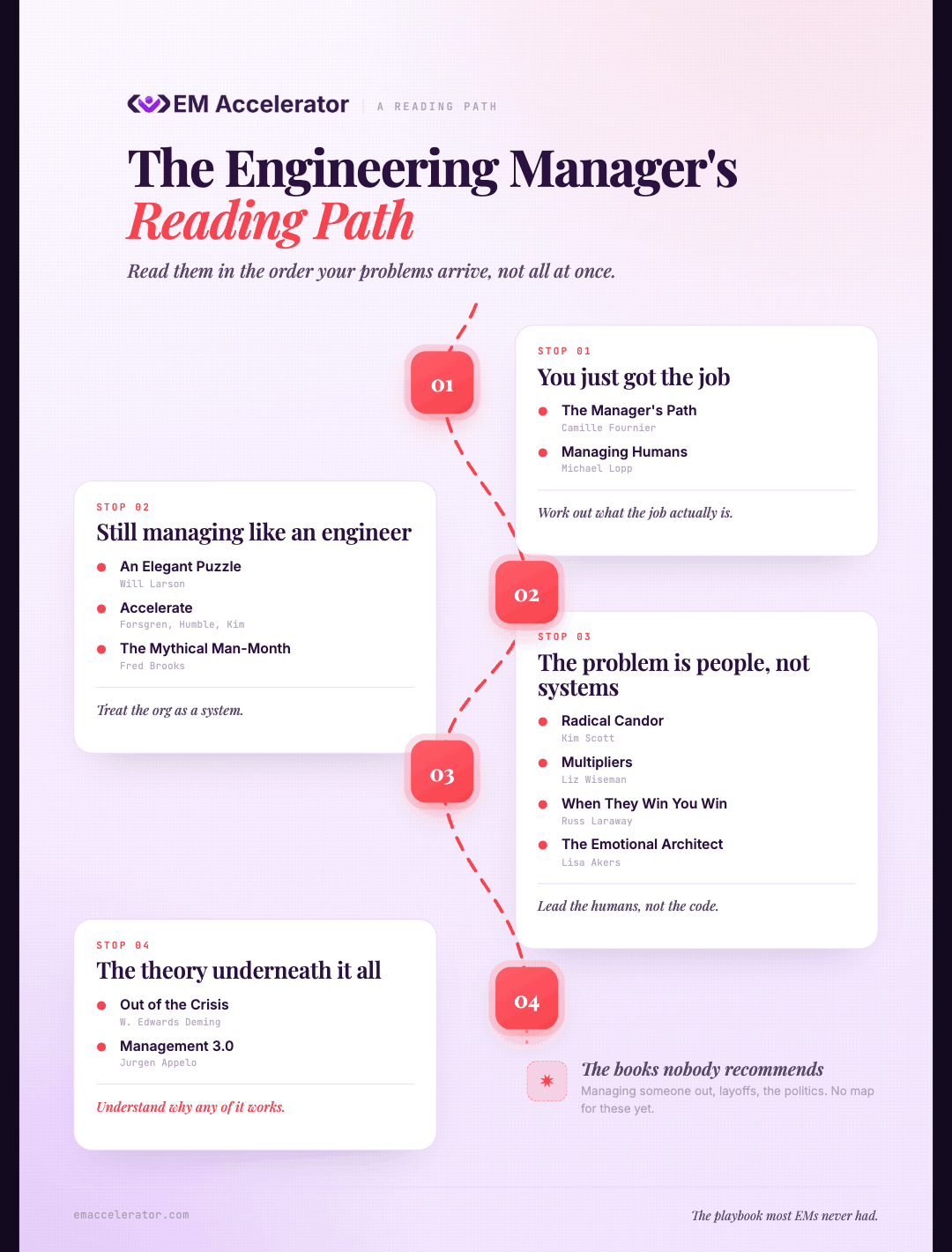
The best engineering management book is the one that actually changes how you manage, which rules out most of the ones people own.
I asked engineering leaders on LinkedIn which management books are worth reading. Dozens of recommendations came back, and the list is strong enough that it is printed in full below, every contributor credited, because I promised I would.
Reading a management book and being changed by one are different acts. Plenty of managers can quote Radical Candor at you, care personally and challenge directly, the whole framework chapter and verse, and have never once given a genuinely hard piece of feedback. The reading feels like progress. Acting on it is the work, and the work is uncomfortable, which is why most people stop at the part that felt like progress.
You can finish An Elegant Puzzle in a weekend. Reorganising your team around what it taught you takes a year and makes people irritated with you in the short term. One of those is reading. The other is the job.
So treat what follows as a map of which book solves which problem, not a stack to grind through to feel qualified. Nobody needs all seventeen of these. You need the one that addresses the thing you are getting wrong right now, and then you need to do something differently because of it. I have grouped them by the problem they actually solve, because that is more useful than ranking them, and I have credited the people who recommended them, because I promised I would.
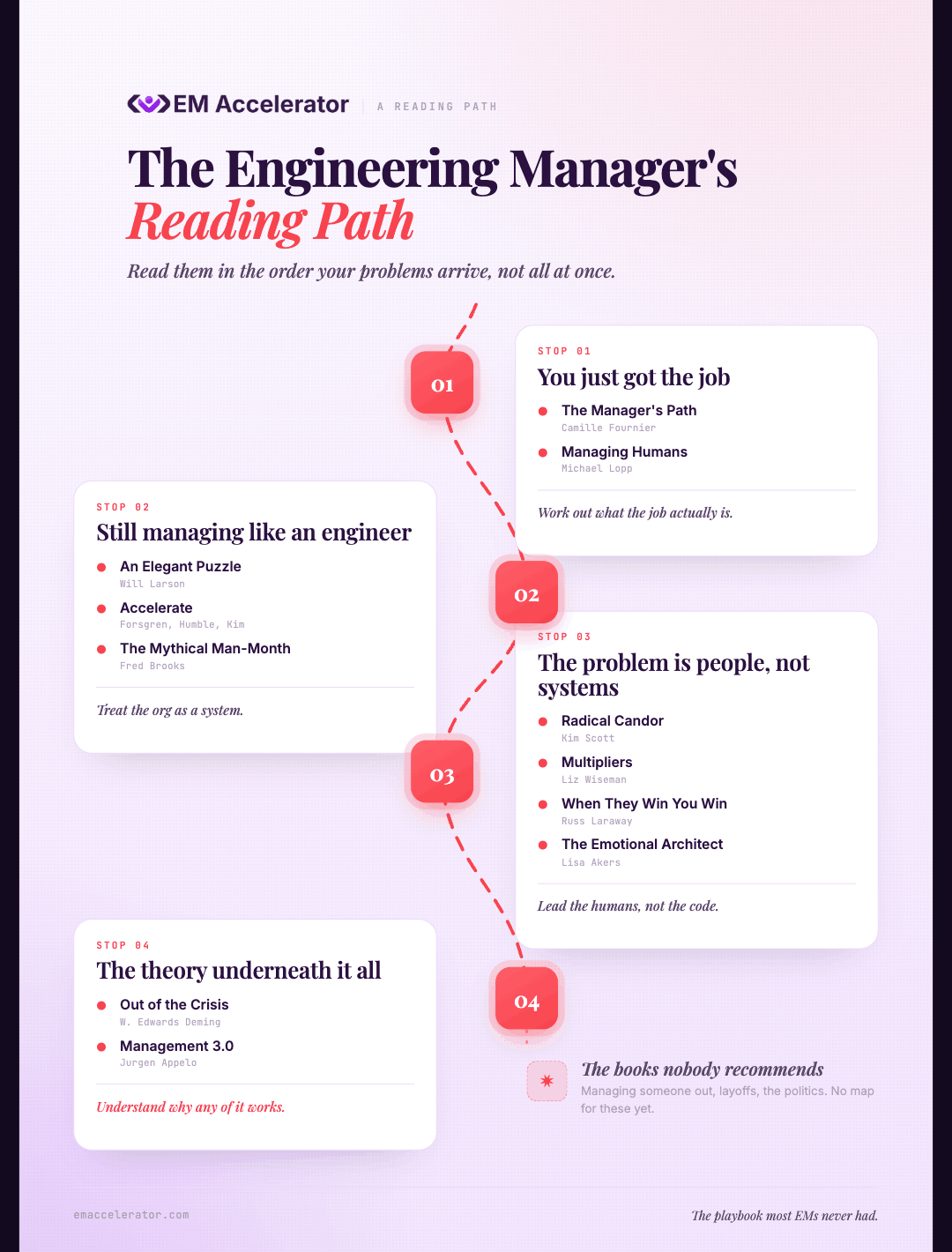
The Engineering Manager’s Reading Path. Download it to save or share.
If you have just got the job
Two books belong in the hands of anyone who was promoted in the last six months.
The Manager’s Path by Camille Fournier, recommended by Mikhail Gubenko, is the one to start with. It walks the actual ladder, tech lead, manager, manager of managers, director, all the way up, and tells you what the job genuinely is at each rung. Its real value is that it kills the assumption most new managers carry without noticing, that “manager” is a single job you either can or cannot do. It is not. It is five or six different jobs wearing the same title, and the skills that make you good at one rung can work against you at the next. Read it early and you skip two years of working that out the hard way.
Managing Humans by Michael Lopp is the other half of the pair, and Owain Lewis was right to name it. Where Fournier gives you the structure, Lopp gives you the texture, the strange reality that your job is now made of people who do not behave like compilers. It is a collection of essays, it is funny, and in your first year it will make you feel considerably less insane. The day you realise that two of your engineers have been quietly avoiding each other for three sprints and it is now your problem, this is the book that tells you that is normal and you are not bad at your job.
If you want the version of this scoped tightly to your opening stretch, I wrote separately about what actually goes wrong in a new engineering manager’s first 90 days, and almost all of it traces back to one shift you have to make in your own head before any book can help you.
If you are still managing like an engineer
This is the most common failure mode for the recently promoted, and the thread served it well. You got the job because you were a strong engineer, so you keep reaching for engineering instincts to solve people and organisation problems. These books are the correction.
An Elegant Puzzle by Will Larson was the most recommended book on the entire thread. Cezar P., Julia Wallin and Owain Lewis all named it, and Cezar referenced it by its subtitle, Systems of Engineering Management, which is the honest pitch. This is the book for the structural side of the job, org design, sizing teams, when to split a group, how to run a migration without it eating a year. It treats management as a systems problem, which is exactly the framing an ex-engineer can hear. Larson is not telling you to feel your way through it. He is telling you the org is a system with inputs and failure modes, and that lands for people who think in systems for a living.
Accelerate by Nicole Forsgren, Jez Humble and Gene Kim came from Mikhail as well, and it is the most evidence-backed book on the list. It is the DORA research, the four metrics that actually correlate with high-performing engineering organisations, written up properly. If you have ever been in an argument about whether your delivery process is any good and had nothing but vibes to bring to it, this gives you the data instead. Read it for the evidence. Then be very careful what you do with it, because the moment a metric becomes a target your team will hit the number and quietly stop doing the thing the number was meant to measure. I wrote a whole piece on measuring engineering teams without breaking them, and it is largely a warning about exactly this trap. Accelerate hands you a loaded weapon. That piece is the safety briefing.
The Mythical Man-Month by Fred Brooks was Martin Gallauner’s pick, and the fact that a book from 1975 still belongs on this list should tell you something. Brooks’s law, that adding people to a late software project makes it later, is fifty years old and managers still try to fix a slipping deadline by throwing bodies at it. If you have ever watched a panicked director “add resources” to a project in the final month and make everything slower, this is the book that explains, calmly and decades in advance, why that was always going to happen.
Staff Engineer, also Larson, came from Cezar P., and it is worth a sharp word because it appeared on a list of books for engineering managers when it is explicitly about the track you chose not to take. It is the senior individual contributor path, the engineer who leads at scale without ever managing anyone. Read it anyway, but not to manage better. Read it to understand the staff engineer on your team who has no interest whatsoever in your job and is quietly more influential than you are. Misunderstanding that person is one of the faster ways to lose your best people.
If your problem is people, not systems
For everyone whose gap is the opposite, plenty of structure and not enough idea what to do when someone cries in a one-to-one, this is the shelf.
Radical Candor by Kim Scott is the obvious one, and Julia Wallin said the quiet part out loud in her comment: everybody knows Radical Candor. That is precisely the problem with it. The framework, care personally and challenge directly, is genuinely good and worth internalising. But it has become the management book people name to signal they take feedback seriously, and most of the managers who cite it have mastered the care-personally half and silently skipped the challenge-directly half. The caring is comfortable. The challenging is the part that makes people defensive and occasionally makes them dislike you for a week. If you read this book and only take the warm half, you have read half a book and you are the manager I described at the top.
Multipliers by Liz Wiseman came from Steve Sitton, and his summary was better than most reviews: two categories, Multipliers and Diminishers, where multipliers use the intelligence of the people around them and diminishers shut it down. The thing the book gets right, and the reason it matters specifically for engineers, is that the diminisher is usually the smartest person in the room who cannot stop being the smartest person in the room. Most newly promoted engineers are accidental diminishers, because being the one with the answer was the entire job until last month, and nobody told them the job had changed. The fix is almost mechanical once you see it. The diminisher answers the question. The multiplier asks the engineer what they would do and then shuts up long enough to let them say it, even when waiting is agony and the answer is sitting right there in your head. The discomfort of that silence is the whole skill.
How to Win Friends and Influence People by Dale Carnegie was Dominic Orim’s recommendation, and it is the oldest and most misread book on the list. It is from 1936, it is not a management book, and the title sounds like a manual for manipulation. The core of it is the opposite of manipulation. It is genuine interest in other people, and the moment you read it as a bag of tricks it stops working, because people can smell technique. Read as a book about actually caring what other people want and think, it holds up almost a century later, which is more than most of what gets published this year will manage.
When They Win You Win by Russ Laraway also came from Owain. Laraway’s argument is that the manager’s job reduces to three things, giving people direction, coaching them, and caring about their careers, and that most managers are weakest on the third. He is right. Direction is the part the company shouts at you about, so it gets done. Career is the part nobody chases you on, so it quietly gets dropped, and then your best engineer leaves and you are surprised, when the truth is you stopped paying attention to where she was going six months ago and she noticed.
The Emotional Architect by Lisa Akers was Julia Mitchell’s recommendation, and it is the newest book here and the most engineer-friendly framing of the soft side on the list. The premise is that you should treat the human system with the same rigour, precision and accountability you would give the technical one. Akers spent three decades as a chief engineer in aerospace, including on NASA’s Orion programme, so this is not management theory from someone who has never shipped anything hard. It is strongest for the manager who is drowning in everyone else’s dysfunction, absorbing every emotional dump on the team and calling it leadership. If that is you, the chapters on boundaries will sting in a useful way.
The Effective Manager by Mark Horstman came from Sean Cooper, and it is the most operational book on the list. It is the Manager Tools system in book form, and its obsession is the weekly one-to-one done properly and consistently. It is not exciting and it is not meant to be. If your problem is that you are inconsistent, that your one-to-ones get cancelled the moment the week gets busy, that you manage by occasional heroics rather than by a steady cadence, this is the book that drills the boring fundamentals into you. The boring fundamentals are usually the ones we are missing.
A couple more came through that I have not read, so I will not pretend to have a view. Sean also named The H-Factor, and Owain pointed to Cate Huston’s writing on engineering leadership. If you have read either and rate it, tell me.
If you want the theory the tactics sit on top of
These are the foundational ones.
Out of the Crisis and The Essential Deming both came from Cezar P., and W. Edwards Deming is the most cited and least finished author on this entire list. People love to mention Deming. Far fewer have read him, because the prose is dense and the man does not care about being an easy read. If you do get through it, the central idea will reframe how you see your own job: roughly ninety-five percent of performance comes from the system, not from the individual, and the manager’s instinct to fix a bad outcome by leaning on a person is usually treating the symptom while protecting the disease. If you have ever stack-ranked a team or run an individual performance plan to fix what was actually a broken process, Deming is the cold shower you have been avoiding. Hard going. Genuinely worth it.
Management 3.0 by Jurgen Appelo came from Mikhail, and it sits in the same bucket. It applies complexity thinking to management and argues for giving teams real autonomy rather than controlling them, which is the right argument. It is also recommended more often than it is finished, for the same reason Deming is. The good ideas are real. You just have to actually read past chapter three to get them.
The books nobody recommended
Look at the shape of the whole list for a second, because the gaps say more than the entries do.
The list is heavy on systems and heavy on inspiration. Now notice what is missing. Nobody recommended a book about managing someone out of the organisation. Nobody named one about delivering a layoff, or sitting in the room when the project you fought for gets cancelled, or the grubby political reality of fighting for headcount you will not get. The genre, and the thread, skews hard towards the parts of the job people enjoy talking about, and away from the parts that actually keep you awake at three in the morning.
That is not a criticism of the people who replied. It is a tell about the genre, and about all of us. Which books you reach for says more about you than it says about the books. The manager who fills the shelf with Larson and Accelerate and never touches anything on feedback usually has a people problem they would rather treat as a systems problem, because systems problems do not make eye contact. The manager with every book on candour and none on org design is usually avoiding a structural decision they already know they need to make.
There is a more uncomfortable version of this. The reason nobody recommends the book on managing someone out is that nobody enjoys the day they have to do it, and we read to feel ready for the parts of the job we like and to avoid rehearsing the parts we dread. But the dreaded parts are the ones that define whether you are any good. Anyone can run a one-to-one with an engineer who is doing well. The job is what you do with the one who is not, and whether you can carry a team through a cancelled project or a missed promotion without half of them quietly checking out. No book on this list will teach you that, and the absence is worth noticing.
I wrote about the five types of engineering manager and the specific blind spot each one cannot see, because the thing holding most managers back is rarely a knowledge gap a book can fill. It is the thing you are constitutionally inclined to avoid, and you tend to avoid it by reading more about the things you are already good at. The reading feels like work. It is often just a more sophisticated way of dodging the thing.
My pick, if you only read one
My pick is The Manager’s Path, and here is the reasoning. For most people reading this, you are newer to the job than you would like to admit, and the thing you are missing is not depth on any single skill. It is a clear picture of what the job even is at your level, and how it changes as you climb. Fournier gives you that more cleanly than anything else on the list, and reading it early stops you from optimising hard for a job you do not actually have yet.
The honest alternatives. If you are past the new-manager stage and your real problem is structural, the org design, the team boundaries, the decisions that move dozens of people, go to An Elegant Puzzle instead. If you know your gap is people and feedback, Radical Candor, but only if you commit upfront to the challenge-directly half, because you have almost certainly got the care-personally half covered already and another book about being kind is not what you need.
Before you buy any of them, if you are brand new, there is a cheaper and faster way to find your gaps than reading. The free New Manager Simulator lets you play out a first 90 days and see where your instincts actually take you under pressure. A book tells you what good looks like. The simulator shows you what you currently do, which is usually the more uncomfortable and more useful information.
Final Thoughts
The manager who reads one of these books and changes one real behaviour beats the manager who has read all seventeen and changed nothing. It is not close. The shelf is not the skill, and a reading list is the easiest possible substitute for the work the reading is supposed to lead to.
So pick the one book that matches the thing you are getting wrong, read it this month, and change one thing because of it. If you do not know which thing you are getting wrong, that is the actual problem, and no amount of reading fixes a blind spot you cannot see. Start by finding out which kind of manager you are with the engineering manager type quiz. Then pick the book that argues with you, not the one that agrees with you.
Thanks to everyone who replied. A few of these went straight onto my list.
Books are one format, and they are the cheapest. They are also the one that leaves you to work out where you are standing on the map. If you have read a few and nothing about your week has changed, the honest comparison of what else is available is here: engineering manager training, and what each kind is actually good at.